One last look before we draw it
Your pages aren't painted yet. Here's every place your story happens and what each page will show — when it looks right, press the button below to start drawing. It takes about 10 minutes, and we'll email you the moment your book is ready.
The places we'll draw
Have a real photo of one of these places — the actual house, a landmark? Click a place to add the photo and lock the AI to it.
What each page will show
01
Page 1 — the words
Once, there was a family who lived on a green hill in England, and their name was Rowley.
The picture
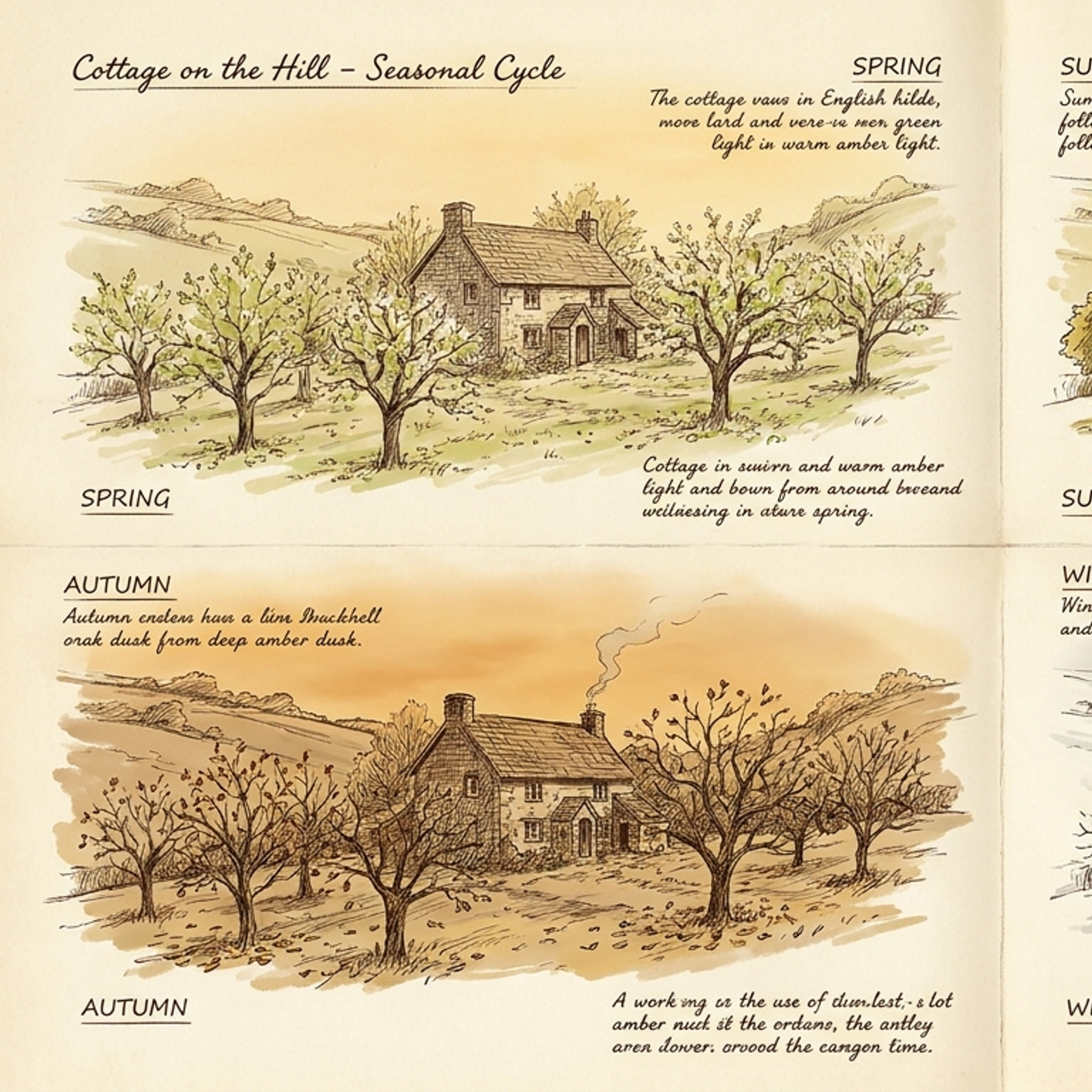
A wide, golden-green English hillside at dusk. A small stone cottage sits among apple trees, smoke curling from the chimney. Through a warm-lit window, the silhouettes of a woman and several children are just visible. The mood is quiet and pastoral — gentle, not yet sad
02
Page 2 — the words
There was a father named William, a mother named Ann Jewell, and seven little children who needed feeding every single day.
The picture
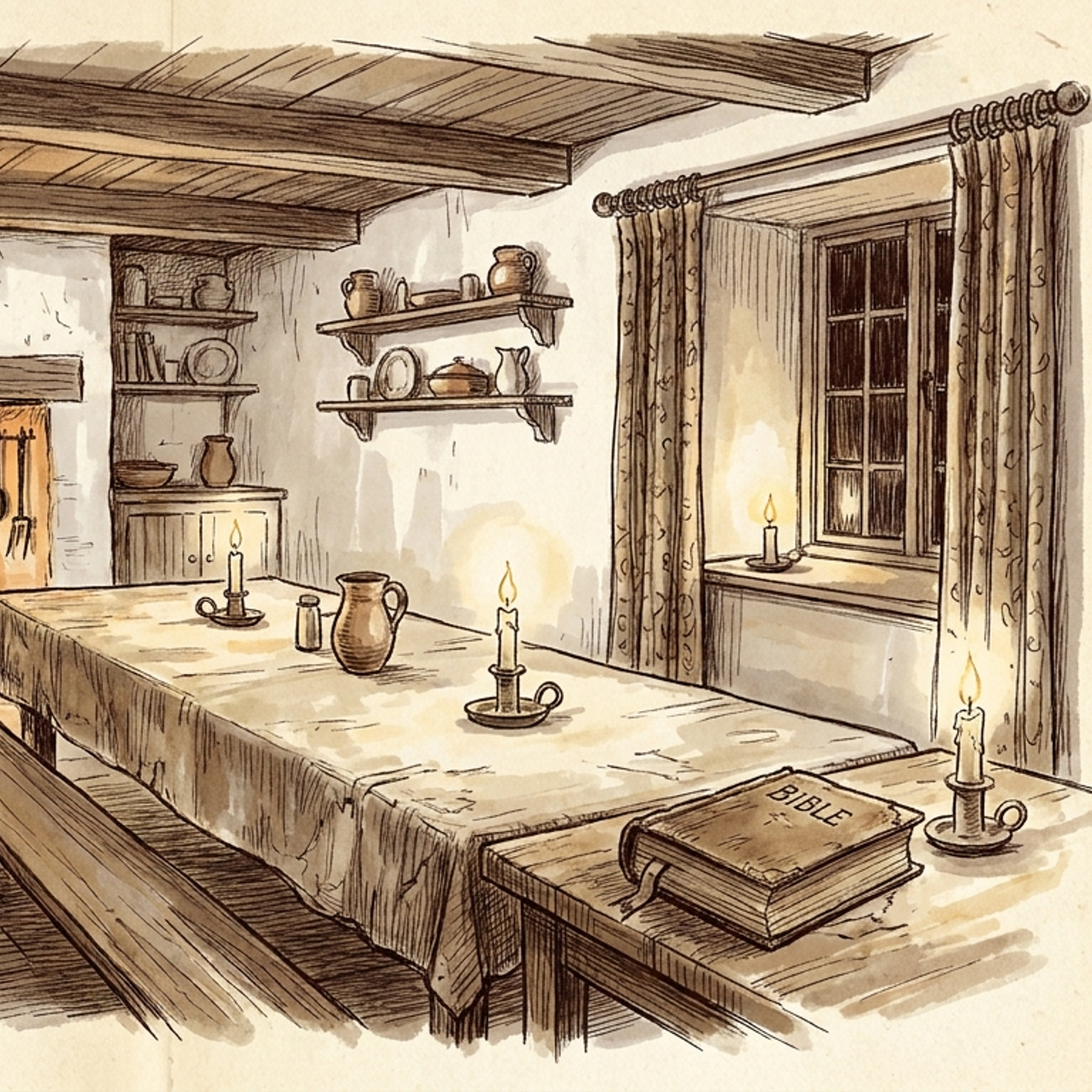
Inside the warm cottage, William sits at the head of a wooden table. Ann stands beside him, a baby on her hip. Around the table are children of varying sizes — some in chairs, some on stools, one small one on a pile of cloth. Bread and a simple bowl of something steam on the table. Everything is worn but clean
"William and Ann Jewell gave birth to seven children between 1837 and 1848."
03
Page 3 — the words
But one cold February, Papa William died, and the world felt very still.
The picture
The cottage at twilight, seen from outside. Snow on the windowsill. A single candle burns in the window. Ann stands in the open doorway, one arm around a small child pressed against her side, looking out at nothing. The orchard trees are bare. The mood is quiet grief, not frightening — still and hushed
"William Rowley died in February 1849, at age 64."
04
Page 4 — the words
Ann was forty-two years old, and her seven children needed her — the oldest just twelve, the youngest only seven months.
The picture
Ann stands in the centre of the cottage, holding a tiny bundled baby. Around her, children of staircase heights — from a toddler clinging to her skirt up to Louisa, the tallest, standing close. Ann looks down at them all, her face soft and serious. She has not looked away. She will not
"She was widowed at age 42. The ages of her seven children ranged from 7 months to 12 years."
05
Page 5 — the words
Ann sat down at the table, and she thought: what can my hands do?
The picture
Ann sits alone at the wooden table in the early morning, before the children are awake. Her hands are flat on the table in front of her. A candle burns. Her eyes are steady, not defeated — she is thinking hard. A basket of cloth sits nearby. This is the moment before she reaches for the needle
06
Page 6 — the words
Ann Jewell was a very good seamstress — her fingers knew exactly what to do with a needle and thread.
The picture
A close-up illustration: Ann's capable hands holding a piece of cloth, a needle catching the light as she draws thread through with practiced ease. The stitches are small and even. Her expression, seen just above the cloth, is focused and calm — this is something she knows how to do
"Fortunately, Ann Jewell was an accomplished seamstress."
07
Page 7 — the words
She sewed gloves, stitch by careful stitch. She sewed long stockings and smock frocks — anything that someone might buy.
The picture
The cottage table spread with finished and half-finished work: a pair of soft gloves laid flat, rolled stockings, a smock frock folded neatly. Ann sews at the centre; beside her, the pieces pile up slowly. Each item is small but made with care. Morning light comes through the window
08
Page 8 — the words
Louisa pulled her chair right up beside Mama and learned to sew too, her fingers doing their best to keep up.
The picture
Louisa sits beside Ann at the table, both of them bent over their sewing. Louisa's stitches are a little bigger than her mother's, her tongue just visible at the corner of her mouth as she concentrates. Ann glances sideways at her daughter with a small, warm smile. A younger child plays quietly on the floor with a spool of thread
09
Page 9 — the words
They sewed in the morning, and they sewed when the candle was lit at night, and the pile of gloves and smocks grew slowly, slowly taller.
The picture
A split-mood illustration: on the left side, morning light fills the cottage and Ann and Louisa sew; on the right side, the same table by candlelight, the same two figures still sewing. The candle has burned low. The pile of finished goods has grown. The room is the same, but the hours have passed — time itself is shown in the changing light
10
Page 10 — the words
Louisa was old enough to find work as a maid in someone else's house, and she went — though she always came home.
The picture
Louisa, in a clean apron, walks down a path away from the cottage toward a larger house in the distance. She looks back over her shoulder — the cottage door is open, and Ann stands in the doorway watching her go, one hand raised. Louisa's wave back is small but certain. She will return
"Her oldest daughter, Louisa, was in her teens and was also able to obtain work as a maid."
11
Page 11 — the words
And Ann's boys, John and Samuel, went to work too — all the way to a brick kiln, miles and miles from home.
The picture
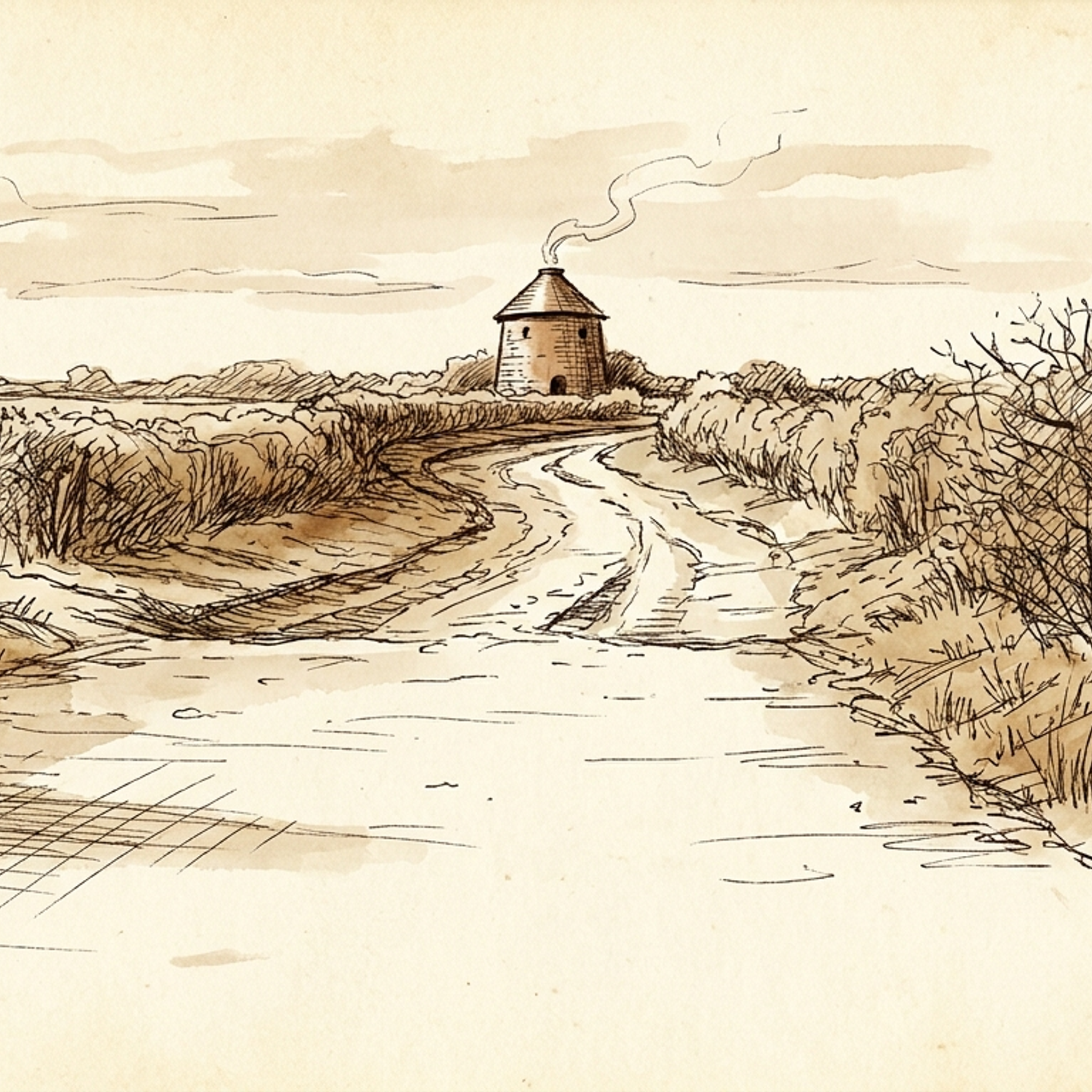
John and Samuel walk together down a long dirt road in the early morning mist, lunchpails swinging. John's boots are too big, Samuel's coat sleeves are rolled up. The brick kiln is a smudge of smoke in the far distance. The road is long. The boys are small on it — but they walk steadily, side by side
"Ann also put the older boys to work. John was about nine years old, and Samuel was seven when their father died. They worked at a brick kiln located some miles from their home."
12
Page 12 — the words
The brick kiln was hot and dusty, and the work was hard for small hands — but John and Samuel did it anyway, because Mama needed them to.
The picture
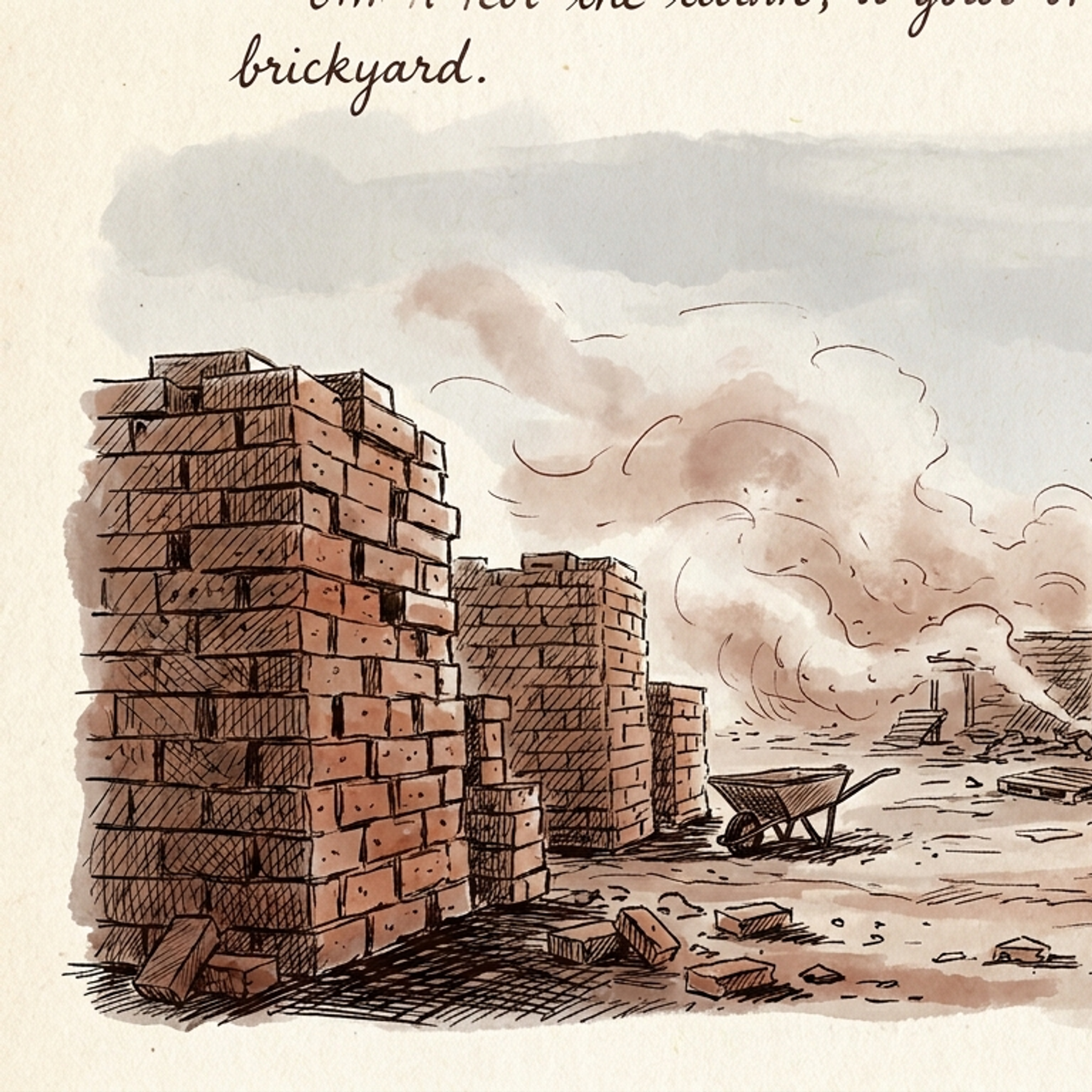
John and Samuel at the brick kiln: stacks of red bricks around them, dusty air, a glowing oven in the background. John carries a flat of bricks with focused effort, Samuel beside him. Their faces are dirty but their expressions are determined. The scene is hard work, not despair — they are doing something important
"Like the children of other poor families, they had to seek work where it could be found and were likely paid a pittance for their labors."
13
Page 13 — the words
At the end of each long day, the boys walked back home — and there was Mama, needle still moving.
The picture
Evening. John and Samuel push open the cottage door, tired and dusty. Inside, the warm firelight spills toward them. Ann is at the table, still sewing — but she looks up the moment the door opens, and her whole face changes. The younger children run toward the boys. The cottage is small but it holds everyone
14
Page 14 — the words
The parish gave the family seven shillings a week — just enough to buy flour for their bread.
The picture
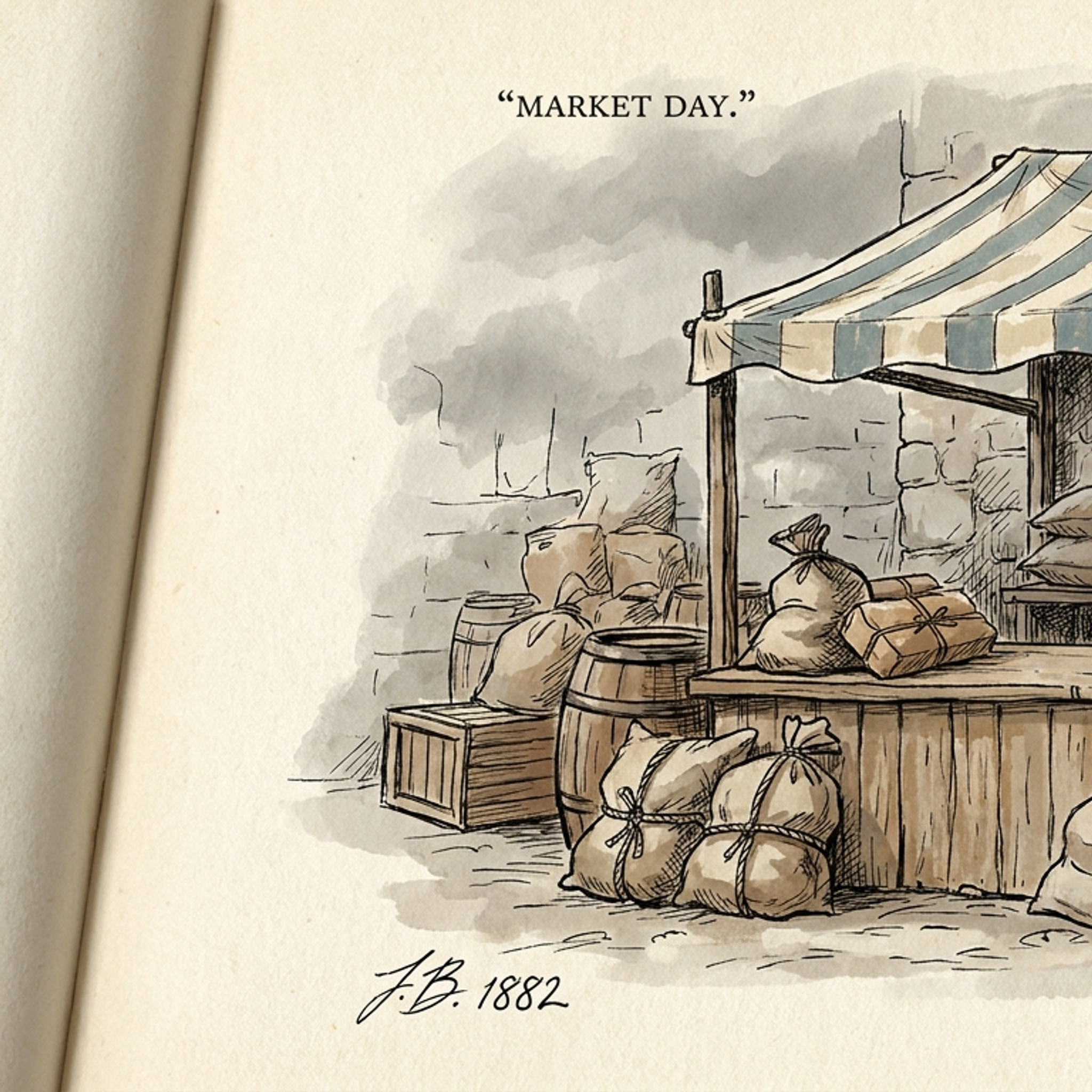
Ann at a market stall, carefully counting coins from a small cloth purse into her palm. The market woman on the other side holds a paper sack of flour. Ann's expression is dignified — she counts carefully, she takes what is enough, she does not look down. The children wait a little behind her
15
Page 15 — the words
Ann took the flour home and made bread, and the bread fed her children, and that was enough for today.
The picture
Ann at the stone hearth, lifting a round loaf from beside the fire. Steam rises from it. The children are gathered close — small faces watching, noses lifted. Samuel reaches out one hand toward the bread. Ann smiles and breaks it apart, handing pieces around. The scene is warm, golden, full of simple satisfaction
16
Page 16 — the words
Ann's brother Thomas and her sister Sarah came to help when they could — and Ann was glad, even when it was hard to need help.
The picture
Thomas and Sarah arrive at the cottage door bearing a basket — maybe bread, maybe wool, something useful. Ann stands in the doorway and takes what is offered. The expression on her face is complicated: grateful and proud at once. Behind her, small children peek around her skirts to see the visitors
17
Page 17 — the words
Some days were very hard. But Ann Jewell did not stop — not for one single day.
The picture
Ann alone at the table very late at night, the candle guttering low, her head bowed slightly over the sewing. She is tired — her shoulders say so. But her hands are still moving. Through the small window, stars. In the background, the sleeping shapes of children bundled together on a bed
18
Page 18 — the words
She thought about the feather bed — the one thing she had kept when everything else was sold.
The picture
The children are piled together asleep on a big, soft feather bed — a cloud of pale linen and small sleeping faces. Ann stands beside it, looking down at them. The bed is the warmest, most treasured thing in the whole cottage. She chose to keep it, and here is why: all of them, sleeping safe
19
Page 19 — the words
She had kept the feather bed so her children would always have somewhere soft and warm to sleep — and there they were.
The picture
A close, tender illustration: Ann's hand resting gently on the edge of the feather bed, near the head of the smallest sleeping child. The child's face is peaceful, one fist curled near a cheek. The room is dark except for the warm glow of firelight. This is the quietest kind of love — a choice made before the hard years came
20
Page 20 — the words
Six years passed. Six whole years of sewing and baking and walking to the kiln and walking home again.
The picture
A gentle montage-style illustration: four small circular scenes arranged on one spread — Ann sewing by a winter fire; John and Samuel on the long road in spring rain; Louisa walking to her work in summer sun; all of them at the table eating bread in autumn. The seasons turn. The family persists
21
Page 21 — the words
The children grew taller. Their hands grew stronger. And Ann's needle never, ever stopped.
The picture
Side by side — the same family, but older now. Louisa is nearly a young woman. John is taller, Samuel's coat actually fits. The younger children have grown too. Ann is at the centre, still holding her sewing, but there is something triumphant in how they stand together — a little ragged, a little tired, but whole
22
Page 22 — the words
Ann had wanted to take all of her children to Zion — a faraway place where their new faith had built a home — and she did not let herself forget it.
The picture
Ann stands at the cottage window in evening light, looking out at the green hills. In her hands is the sewing — always the sewing — but her eyes are distant, dreaming westward. On the table behind her, the pile of finished gloves and stockings is larger than ever. The window frames her like a picture: a woman holding two things at once — what is, and what will be
"Ann replied that her most fervent desire was to take all of her children to Zion."
23
Page 23 — the words
She had worked, and she had hoped, and she had kept them all together — every last one.
The picture
The whole family gathered inside the warm cottage — Ann at the centre, children around her, Louisa beside her, John and Samuel at the edges with the younger ones between. Everyone is present. The room is small and the furniture is worn, but they are all there. Ann's hands rest in her lap, finally still for a moment, the sewing set aside
"Ann Jewell Rowley, widow, mother of seven, and valiant daughter of God."
24
Page 24 — the words
That is what love looks like sometimes — a needle and thread, moving and moving, keeping everyone warm.
The picture
The final spread: a close, warm illustration of Ann's hands at rest on the table — the needle set down beside a finished glove. Around her hands, just at the edges of the illustration, are small details: a corner of a child's sleeve, a piece of bread, a spool of thread, a flickering candle. Everything she made and kept. A bedtime-still, golden-warm ending
See something off? Change what a picture will show, or add a note — fixing it here is free, before any image is made. To change the words, use the Story step. You can still redraw or edit any page afterward; nothing here is final.