One last look before we draw it
Your pages aren't painted yet. Here's every place your story happens and what each page will show — when it looks right, press the button below to start drawing. It takes about 10 minutes, and we'll email you the moment your book is ready.
The places we'll draw
Have a real photo of one of these places — the actual house, a landmark? Click a place to add the photo and lock the AI to it.
What each page will show
01
Page 1 — the words
The ship moved slowly across the Pacific, and the ocean went on forever in every direction. Wayne Wilberg stood at the rail and watched the horizon — flat, blue, and perfectly empty.
The picture
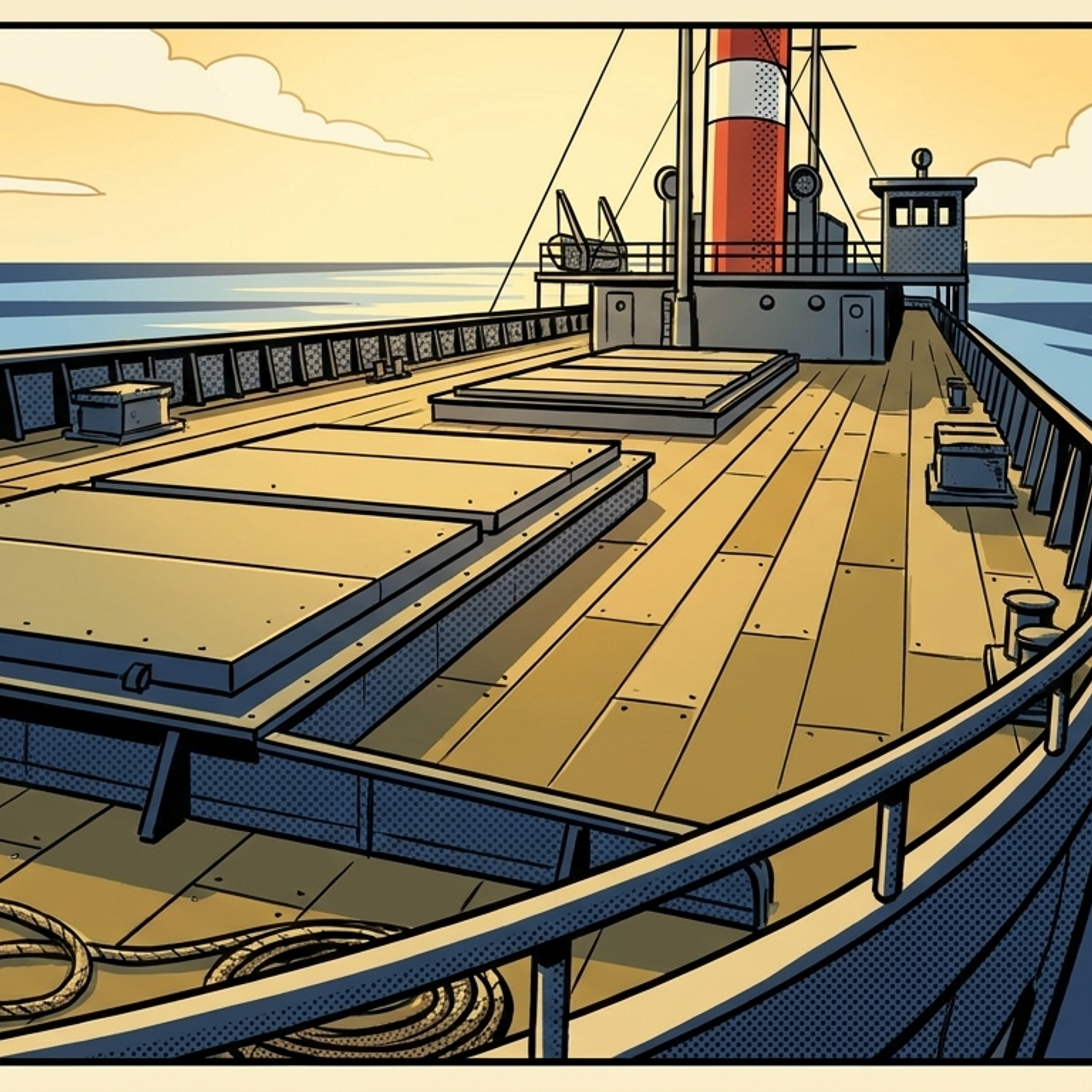
Wide, sun-warmed afternoon light. Wayne stands alone at the gray steel railing of a large transport ship, left hand resting flat on the rail, olive-green dungarees, dog tag glinting at his collar. The ocean stretches away in every direction — deep blue, completely flat — and the horizon is a clean, unbroken line with nothing on it. The ship's steel deck gleams. The mood is calm, almost drowsy. The illustration should feel vast and unhurried: a small young man against an enormous, empty world
"they ended up in the Atlantic, just cruising along at no more than two or three knots per hour"
02
Page 2 — the words
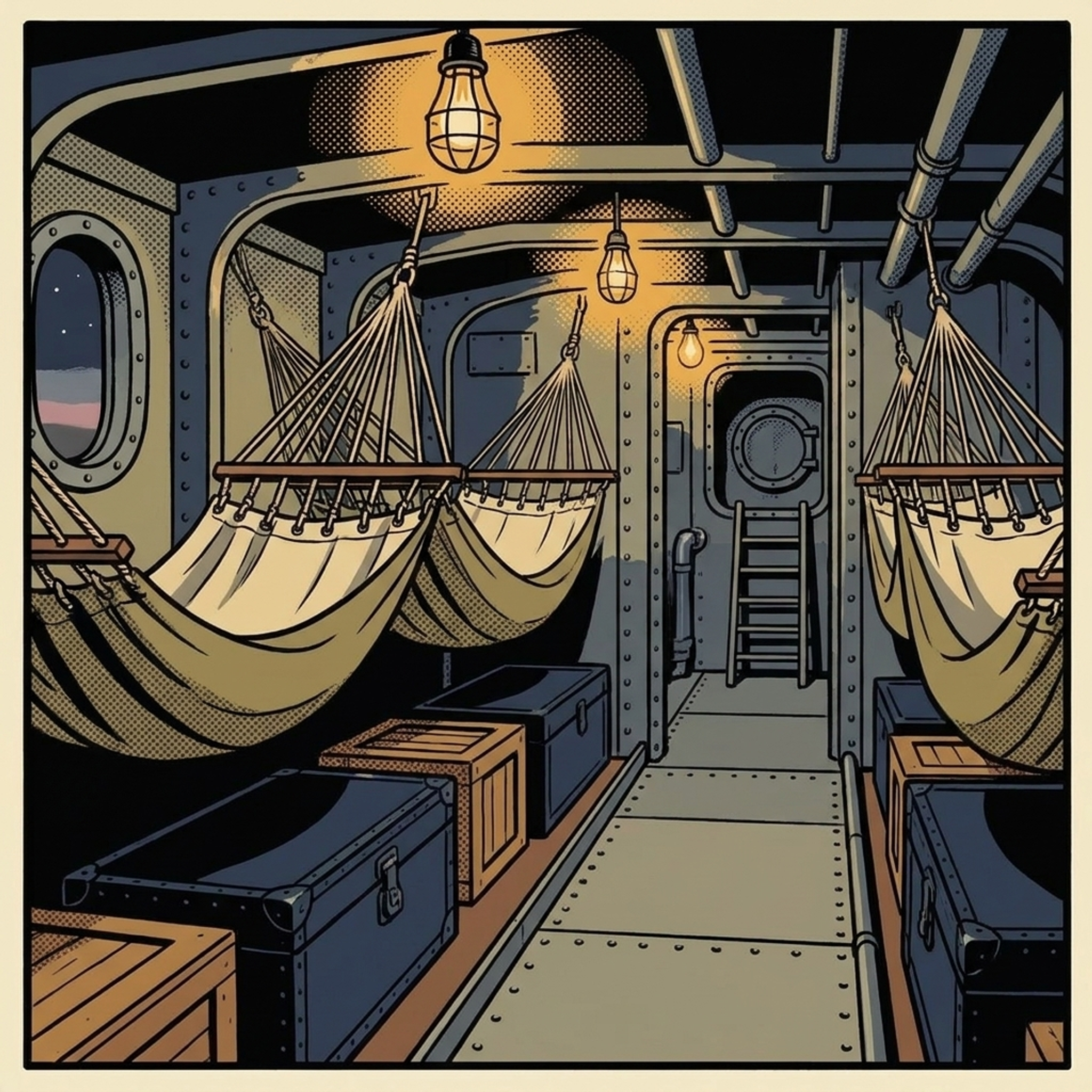
Below decks, the air smelled like salt and metal. Men wrote letters home, played cards, and climbed into their hammocks as the ship rocked them gently back and forth. Wayne pulled off his boots and lay down. Through the porthole beside him, the world was nothing but black water and an empty sky.
The picture
Below decks: a low-ceilinged space lit by bare bulbs, rows of rope hammocks slung close together. Some men sit on footlockers writing on paper, others hold playing cards. Wayne is in the foreground, boots in hand, one knee up on his hammock, glancing sideways at a small round porthole. Through the porthole: only dark water and a strip of black sky. Warm amber light, cozy but cramped. The mood is sleepy and ordinary — bedtime on a very unusual bed
03
Page 3 — the words
In the middle of the night, Wayne woke up. Something was wrong. The whole ship was shaking — the walls, the floor, the hammock itself — shuddering and trembling like something enormous had grabbed hold of it. The engines were ROARING.
The picture
Deep nighttime below decks. Wayne jolts awake in his hammock, eyes wide open, one hand gripping the rope side. The overhead bulb swings slightly. Around him other men are stirring — heads lifting, eyes blinking in the dimness. Motion lines or slight blur on the hammock ropes and the hanging lamp suggest vibration. The porthole shows only black. The mood is sudden, jarring, alarmed — the ordinary ship has become something else entirely
"In the middle of the night they felt the ship really starting to shake and shudder like it was really going somewhere fast"
04
Page 4 — the words
Wayne sat up and gripped the ropes on both sides of his hammock. Men around him were wide awake now, eyes finding each other in the dark. From the passageway came an officer's sharp voice: "Stay below. Stay where you are." Nobody moved. The ship only went faster.
The picture
Wayne sits upright in his hammock, both hands gripping the rope edges, boots half-on. Around him several Marines are also sitting up — faces tense, eyes big. In the narrow steel passageway just visible beyond an open hatch, the silhouette of an officer stands with one hand on the frame, pointing back. The single swinging bulb casts moving shadows. The mood is tightly coiled — fear without information, the worst kind of waiting
05
Page 5 — the words
Hours went by. The engines did not slow down. Wayne lay on his back and stared up at the ceiling, listening to the roar and the rush of the water — and through the porthole, the horizon was still just black. Still nothing. Still no answers.
The picture
Wayne alone in his hammock, eyes open and staring at the low steel ceiling above him, left hand resting flat on his chest. The other hammocks are empty — men have moved away or pressed into corners. The porthole in the illustration is centered: a small, perfect oval of pure black. The engines' power is suggested by faint vibration lines along the hull walls. The mood is the long, hollow weight of not knowing — the hardest kind of brave
06
Page 6 — the words
Then — at last — a thin gray line appeared along the edge of the porthole. Dawn. Wayne sat up so fast his hammock swung wide. He grabbed his boots, yanked them on, and headed for the ladder.
The picture
The porthole is now the center of the illustration: through it, the faintest gray-pink light edges the black. Wayne is already in motion — caught mid-swing off the hammock, one boot on, one in his hand, face turned toward the ladder at the far end of the compartment. The ladder leads up toward a hatch with pale light leaking around its edges. The mood shifts from dread to urgency — forward, upward, toward the answer
07
Page 7 — the words
Wayne pushed open the heavy hatch. Cold salt air rushed over him. He stepped out onto the deck — and stopped. His boots stopped moving. His hand stopped pushing. He stood very still, staring.
The picture
Wayne is framed in the open hatch from behind — we see him from below, looking up at the back of his figure as he emerges into the pale dawn light. His left hand is still on the hatch handle. Ahead of him, the deck stretches forward but the illustration cuts off there — the reader cannot yet see what he sees. The sky above is pearl-gray and pink at the edges. The mood is pure suspense: the held breath before the world changes
08
Page 8 — the words
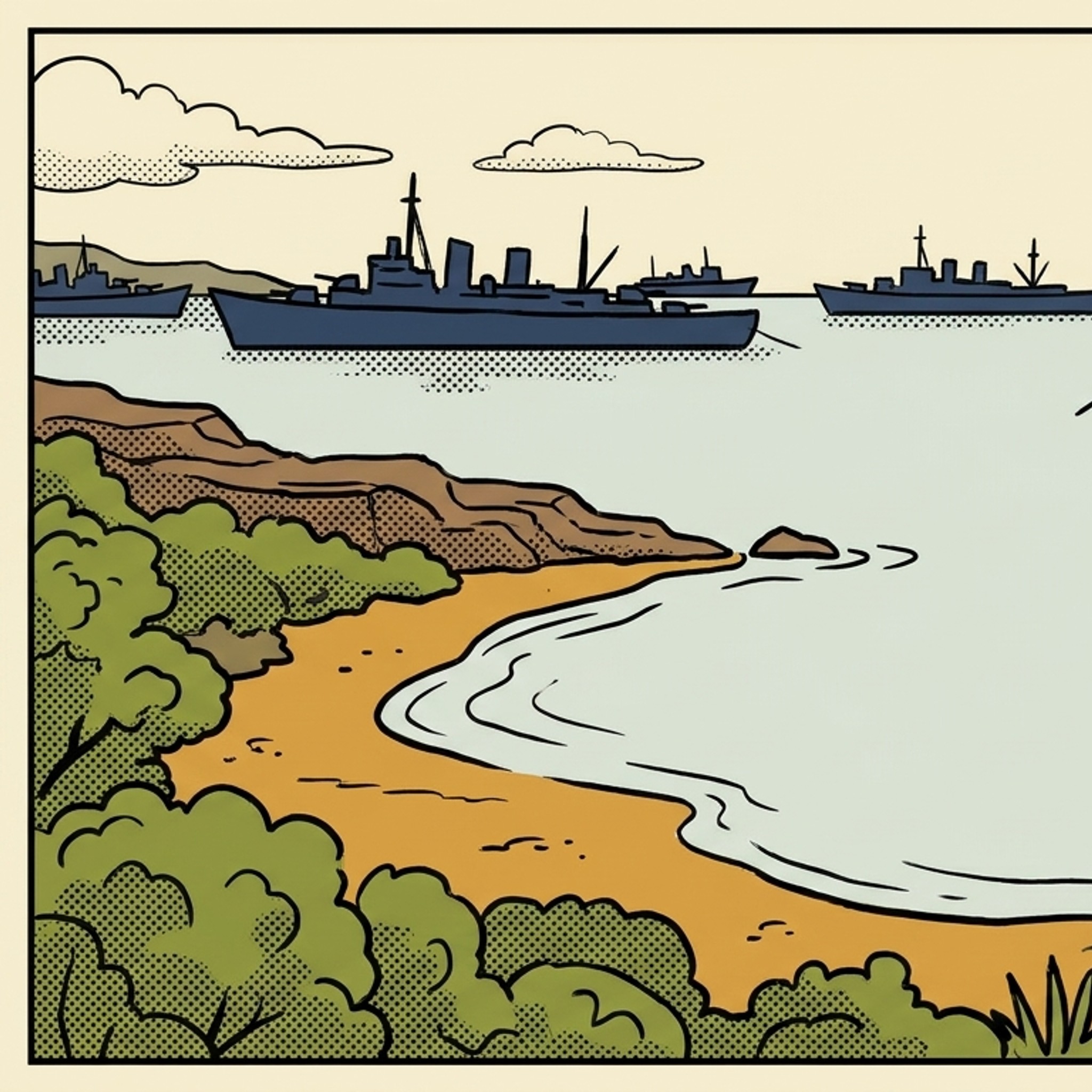
Ships. Ships to the left of him. Ships to the right of him. Ships ahead and ships behind — when they got up on the deck in the morning they could see "an enormous fleet of American ships as far as the eyes could see from horizon to horizon."
The picture
The full double-spread illustration opens wide: Wayne stands at the center of the deck, small against the enormous scene around him. In every direction — left, right, ahead, behind — gray steel ships fill the ocean. Destroyers, transports, carriers of every size crowd the water. The horizon, which was empty last night, is now a jagged line of masts and hulls. Dawn light — gold and pink — catches the metal and the waves. Wayne's arms hang at his sides, mouth slightly open. The mood is overwhelming, world-stopping awe
"when they got up on the deck in the morning they could see an enormous fleet of American ship as far as the eyes could see from horizon to horizon"
09
Page 9 — the words
Other Marines came up through the hatch behind him. One by one they stepped onto the deck and stopped, just like Wayne had stopped. Nobody said anything. They just looked — left, right, ahead, behind. The horizon that had been empty all night was full.
The picture
A line of four or five Marines stand at the ship's railing beside Wayne, all facing outward, all looking at the fleet. Their faces show the same wide-eyed stillness — slack jaws, hands resting on the rail. Wayne is first in the line, his left hand flat on the railing as always. The ships stretch away behind them in both directions. The mood is shared, communal awe — the quiet that comes when something is too big for words
10
Page 10 — the words
The man beside Wayne finally whispered, "Where did they all come from?" No one answered. They had all been sailing through the same dark night — and the darkness had pulled them together.
The picture
Close on Wayne and the Marine standing next to him at the rail — a slightly older man with a round face, mouth barely open in a whisper, eyes still fixed on the horizon. Wayne turns his head just slightly toward the voice, profile visible, expression unreadable — somewhere between wonder and something heavier. The ships are soft in the background, a gray-steel forest stretching away. The mood is intimate inside the enormous: two small men trying to find words for something much larger than words
11
Page 11 — the words
Word moved along the deck from man to man, quiet and certain: Okinawa. That was where they were going. Wayne said it to himself — Okinawa — and this time it wasn't just a name on a map. "This was to be the invasion force of Okinawa."
The picture
Wayne stands apart from the group now, hands on the rail, looking forward toward the horizon ahead. His lips are slightly parted — he is saying the word to himself. Around him, other men are leaning in to each other, mouths near ears, passing the name along. The fleet stretches ahead of them, all ships pointed in the same direction. The mood is quieter, more solemn — the awe has found its name, and the name carries weight
"This was to be the invasion force of Okinawa"
12
Page 12 — the words
Wayne stayed at the rail as the sun climbed higher and the fleet held its shape — ship after ship after ship, all of them pointed toward the same horizon, all of them moving forward together. He was one part of something enormous. He did not look away.
The picture
The final illustration: Wayne at the rail, viewed from slightly behind and to the side, the full morning sun now golden on his face and on the sea. The fleet stretches ahead — the horizon is full of ships, all moving in the same direction, a city of steel on the water. Wayne's left hand rests flat on the rail. His posture is upright, steady, still. The mood is resolute and quietly hopeful: the unknown has become something vast and real, and he is part of it
"when they got up on the deck in the morning they could see an enormous fleet of American ship as far as the eyes could see from horizon to horizon"
See something off? Change what a picture will show, or add a note — fixing it here is free, before any image is made. To change the words, use the Story step. You can still redraw or edit any page afterward; nothing here is final.